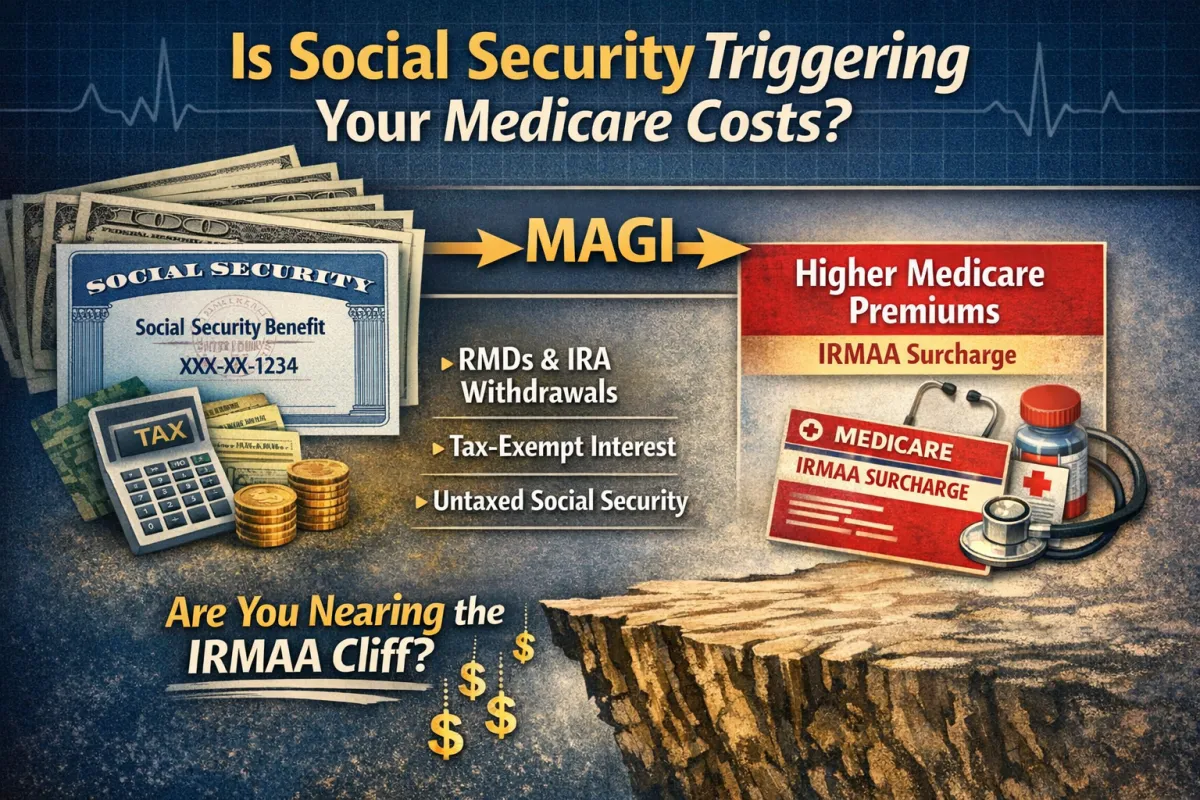
The Social Security Trap: How High Income Impacts Your Medicare Costs
By Dora Wysocki
For many of our clients with $1M or more in retirement plans, Social Security is often viewed as "extra" income. However, for high-net-worth retirees, Social Security can actually become the trigger that makes your healthcare significantly more expensive.
The MAGI Connection
Medicare doesn't just look at your "taxable" income; it looks at your Modified Adjusted Gross Income (MAGI). For IRMAA purposes, this includes:
Your Adjusted Gross Income (AGI): This includes IRA withdrawals and RMDs.
Tax-exempt interest: (Such as Municipal Bonds—many retirees don't realize these count for IRMAA!).
The untaxed portion of Social Security.
The "Double Hit" on High Earners
If you and your spouse are receiving maxed-out Social Security benefits, you might already be halfway to the first IRMAA threshold before you even touch your investments. When you then layer on RMDs from a $1.7M Traditional IRA, you aren't just paying more in income tax—you are effectively "taxed" again through higher Medicare premiums.
Why Diversification is the Only Cure
If 100% of your wealth is in "pre-tax" accounts (Traditional 401k/IRA), you have zero control over your MAGI. You are forced to take distributions, and those distributions force you into higher IRMAA tiers. To stay below the "cliffs," you must have assets that do not report to the IRS as income.
Planning Tip: Strategic shifts into Tax-Free Retirement Accounts can help you keep your Social Security checks whole. Want to know your number? Schedule a strategy session today.
The information provided in this article is for educational and informational purposes only and does not constitute financial, investment, tax, or legal advice. IRMAA thresholds and Medicare premiums are subject to change annually by the Social Security Administration and CMS. While we strive to provide accurate and up-to-date information based on 2026 projections, you should consult with a qualified tax professional or financial advisor regarding your specific situation before making any financial decisions. Past performance of any strategy or investment is not indicative of future results.
