The "Average Return" Trap: Why Retirees Are Being Sold a Financial Time Bomb
By Dora Wysocki, CAS®
If you are nearing retirement or have already handed in your keys, you’ve likely heard the "Golden Rule" of financial planning:
"Don't sweat the market swings. Historically, the S&P 500 returns an average of 7% to 8%. As long as you stick to the average, your nest egg will last."
It sounds comforting. It sounds scientific. But for a retiree, this is the most dangerous lie in the financial world.
The math used to build your retirement is often fundamentally different from the math required to survive it. Why? Because you don’t live on "averages." You live on monthly CASH FLOW.
The "Paycheck" vs. "The Portfolio"
When you were working, market volatility was your friend. If the market dropped, your 401(k) contributions simply bought more shares at a discount. You had time.
But the day you retire, the game flips. You are no longer a "buyer"; you are a "seller." You now have to sell pieces of your nest egg every single month to replace your paycheck. This is where the Average Return Lie turns deadly.
The Brutal Reality: A Tale of Two Retirements
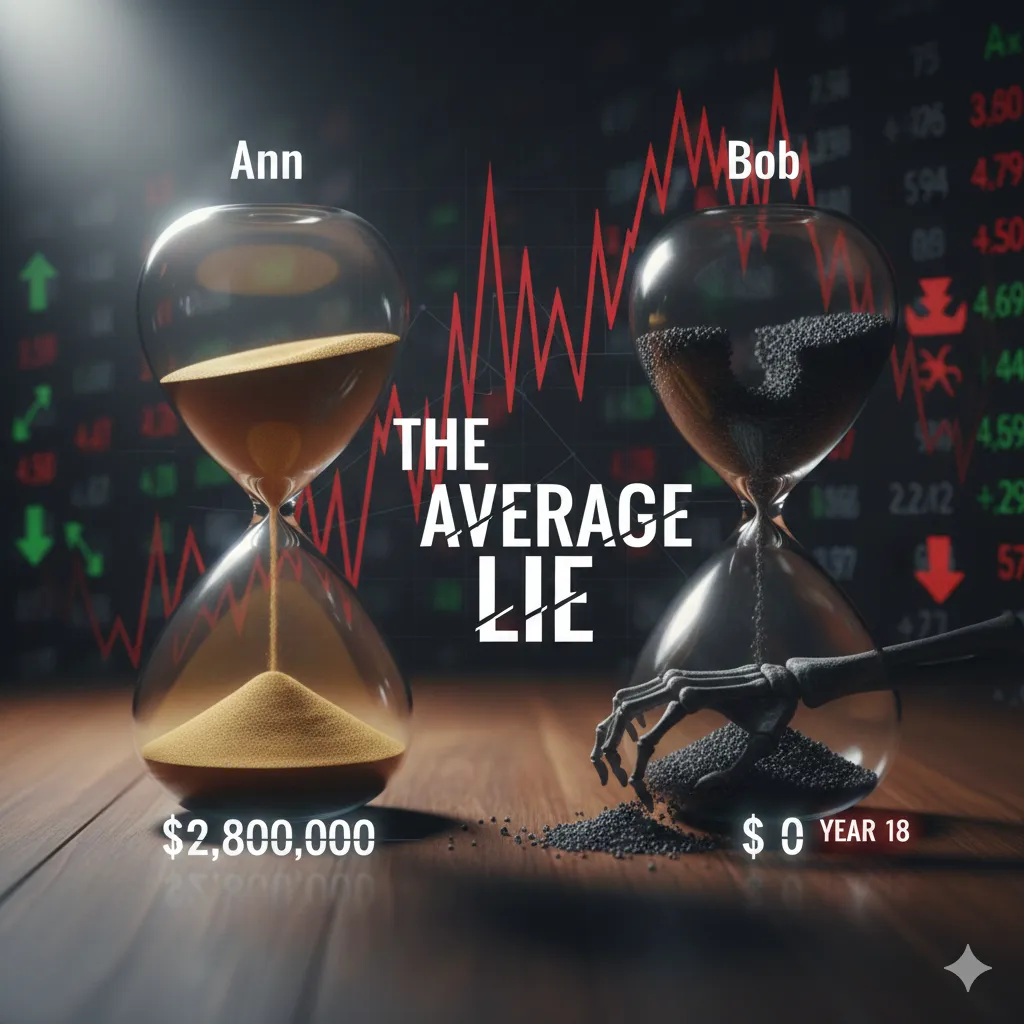
Consider two retirees, Ann and Bob. Both retired with $1,000,000. Both need $50,000 a year (plus 3% for inflation) to maintain their lifestyle. Both experienced a 6% average return over 25 years.
Ann: The "Smooth" Transition
Ann retired during a bull market. Her portfolio grew in the first few years. Because her account balance was high, her $50,000 withdrawals were "easy" for the portfolio to handle.
The Result: After 25 years, Ann still has $2.5 Million left to leave to her kids.
Bob: The "Sequence" Disaster
Bob retired into a bear market (like 2008 or 2022). His portfolio dropped 15% in Year 1. But Bob still had to pay his property taxes and buy groceries, so he took his $50,000 anyway.
The Double Whammy: Bob didn't just lose money in the market; he was forced to cannibalize his principal when it was at its lowest point.
The Result: Even though Bob’s "average" return was the same as Ann’s, Bob ran out of money in Year 18.
The Lesson: Bob didn't go broke because of a bad "average." He went broke because his casflow needs forced him to sell assets during a downturn. Once those shares are gone, they can never "bounce back."
Why Averages Fail the "Retiree Stress Test"
Averages Ignore "The Sequence": In retirement, the order of your returns matters more than the returns themselves. A bad first three years can ruin a thirty-year retirement.
Averages Ignore Inflation: A 7% return doesn't help if the cost of healthcare and housing is rising at 5%. You aren't looking for "growth"; you're looking for purchasing power.
Averages Ignore Stress: You cannot "wait for the long term" when you have a mortgage due on the 1st of the month.
How to Build a "Sequence-Proof" Retirement
If you want to sleep through a market crash, you have to stop managing for Total Return and start managing for Reliable Income.
The Cash Buffer: Keep 24 months of spending in "boring" cash accounts. If the market crashes, you spend the cash and let your stocks recover.
Focus on Yield: Shift toward assets that pay you (dividends, interest, rental income). If your income comes from the yield rather than selling shares, the daily price of the stock market becomes irrelevant to your lifestyle.
Solve for the Worst Case, Not the Average: Your plan should work even if the market stays flat for a decade.
The Bottom Line
Averages are for mathematicians; cash flow is for people who want to stay retired. Don't let a "7% average" talk you into a strategy that leaves you broke at 80. Let's chat
Important Disclosure
For Informational Purposes Only: This content is provided for educational and illustrative purposes only and does not constitute financial, investment, legal, or tax advice. The "Ann vs. Bob" case study is a hypothetical example used to demonstrate the concept of Sequence of Returns Risk and does not represent the performance of any specific investment or account.
Investment Risk: All investing involves risk, including the potential loss of principal. Past performance is no guarantee of future results. Market "averages" are historical and do not predict future performance.
Not a Solicitation: This blog post is not an offer to buy or sell any security or to participate in any particular investment strategy. Every individual’s financial situation is unique; you should consult with a qualified financial advisor, CPA, or attorney before making any significant financial decisions.
Cash Flow Strategies: While strategies such as "The Bucket Method" or "Income-Producing Assets" can help mitigate certain risks, they do not guarantee profit or protection against loss in declining markets.
