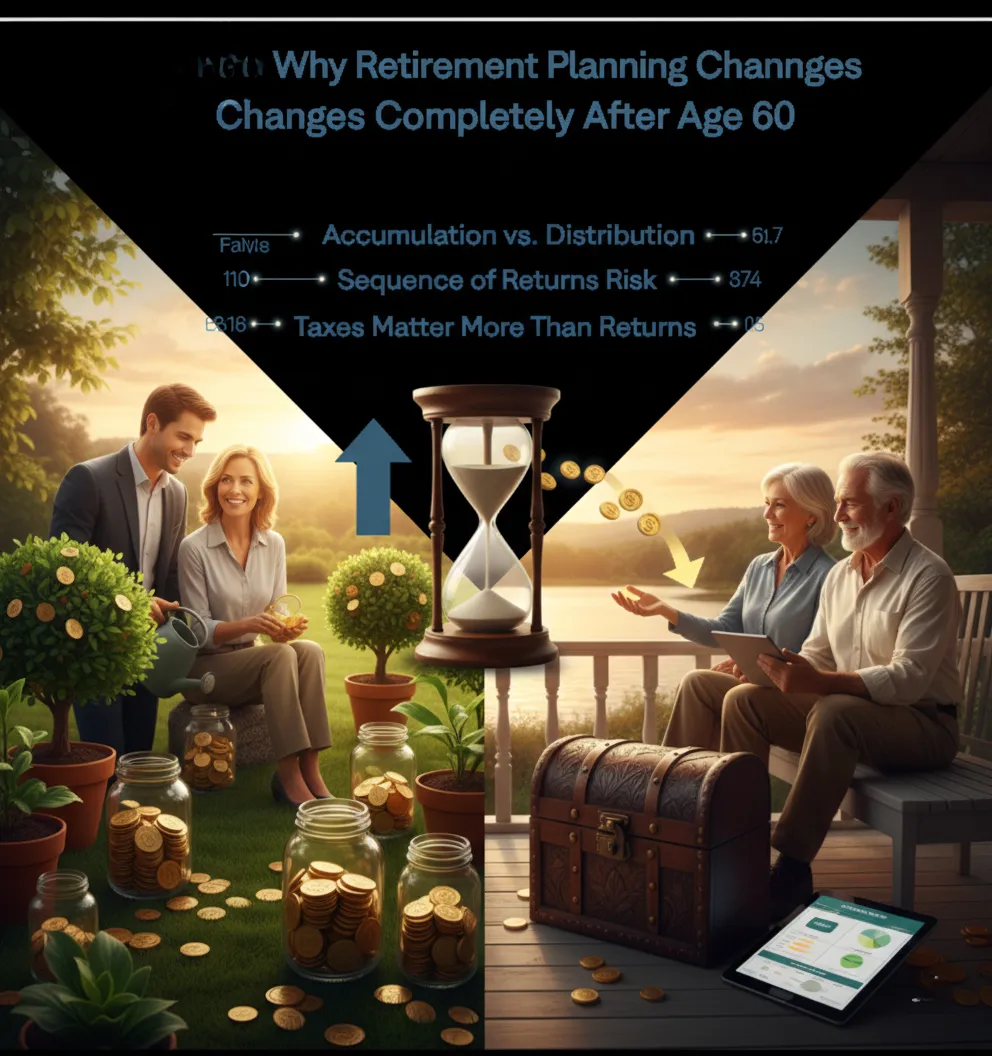
Why Retirement Planning Changes Completely After Age 60
By Dora Wysocki
For decades, the "winning" strategy for your finances was simple: Accumulation. You worked, you saved, and you watched your account balances grow. But once you cross the threshold of age 60, the rules of the game don't just change—they flip entirely.
At this stage, your priority must shift from growing wealth to sustaining it. Here is why the strategies that got you to retirement are often the same ones that can jeopardize your security during retirement.
1. Accumulation vs. Distribution: The Great Pivot?
In your 40s and 50s, market volatility is largely an inconvenience. If the market drops 20%, you have time and a paycheck to wait for a recovery.
After age 60, you enter the Distribution Phase. Now, market volatility interacts directly with your withdrawals. Taking money out of a declining account is a "double hit" that can deplete a portfolio faster than any spreadsheet could predict. In retirement, net income is a far more important metric than gross performance.
2. The Hidden Threat: Sequence of Returns Risk?
Most investors understand average annual returns, but few understand Sequence of Returns Risk.
The Concept: If you experience a series of negative market years early in your retirement—while you are simultaneously withdrawing funds for living expenses—the math of your portfolio can change permanently.
Even if the market eventually recovers, your principal may be too depleted to participate in the rebound. This is why specialized income planning and "de-risking" certain assets becomes vital as you approach your mid-60s.
3. Why Taxes Matter More Than Returns?
A common retirement myth is that you will be in a lower tax bracket once you stop working. For many high-earners, the opposite is true. As retirement progresses, several factors can cause your tax liability to spike:
Required Minimum Distributions (RMDs): Forced taxable income from your IRAs.
Social Security Taxation: Up to 85% of your benefits can be taxed depending on your "provisional income."
IRMAA Surcharges: Higher income can lead to significantly higher Medicare Part B and Part D premiums.
Managing the timing of your distributions is often more impactful to your lifestyle than the specific performance of your underlying investments.
4. Building a Compliant, Reliable Income Stream
I focus on helping retirees transition from the uncertainty of "hoping the market stays up" to the certainty of "knowing the bills are paid."
Modern retirement planning isn't about sales pitches; it's about Risk Management. By implementing strategies that account for longevity and tax efficiency, you can stop worrying about the "what-ifs" of the stock market and start enjoying the "what-now" of your retirement.
General Information Only: This content is provided for educational and informational purposes only and does not constitute individual financial, investment, tax, or legal advice. The strategies discussed may not be suitable for all investors.
