Why Converting Less Can Save You Thousands in 2026
By Dora Wysocki
As we move into the 2026 tax year, the rules of engagement for retirees have changed. With the sun-setting of previous tax cuts and the introduction of the $6,000 Enhanced Senior Deduction, the "standard" advice to convert as much as possible is now officially dangerous.
In this case study, we look at why a smaller Roth conversion can actually leave more money in your pocket by avoiding a collision between Social Security, Medicare, and new federal deduction phase-outs.
🔎 The Client Profile (2026)
Age: 68 (Single Filer)
Location: West Virginia
Fixed Income: $42,576 (Social Security only)
Goal: Move Traditional IRA funds to a Tax-Free Roth to reduce future RMDs.
The West Virginia Advantage
Living in West Virginia in 2026 provides a unique benefit: Social Security is now 100% exempt from state income tax. While this is great news for your state return, it makes your Federal tax strategy the primary battlefield. Because the state isn't taking a bite, every dollar you "save" from the IRS stays directly in your pocket.
The "Tax Torpedo" & The New Senior Deduction
Most retirees think of tax brackets as flat stairs. In reality, they are more like a complex puzzle. In 2026, two specific "hidden" factors can make a Roth conversion much more expensive than the 22% bracket suggests:
Social Security Taxation: As your income rises, up to 85% of your Social Security becomes taxable at the federal level.
The Senior Deduction Phase-out: The new $6,000 deduction for those 65+ is a "use it or lose it" benefit. As your Adjusted Gross Income (AGI) climbs toward $100,000, this deduction begins to disappear.
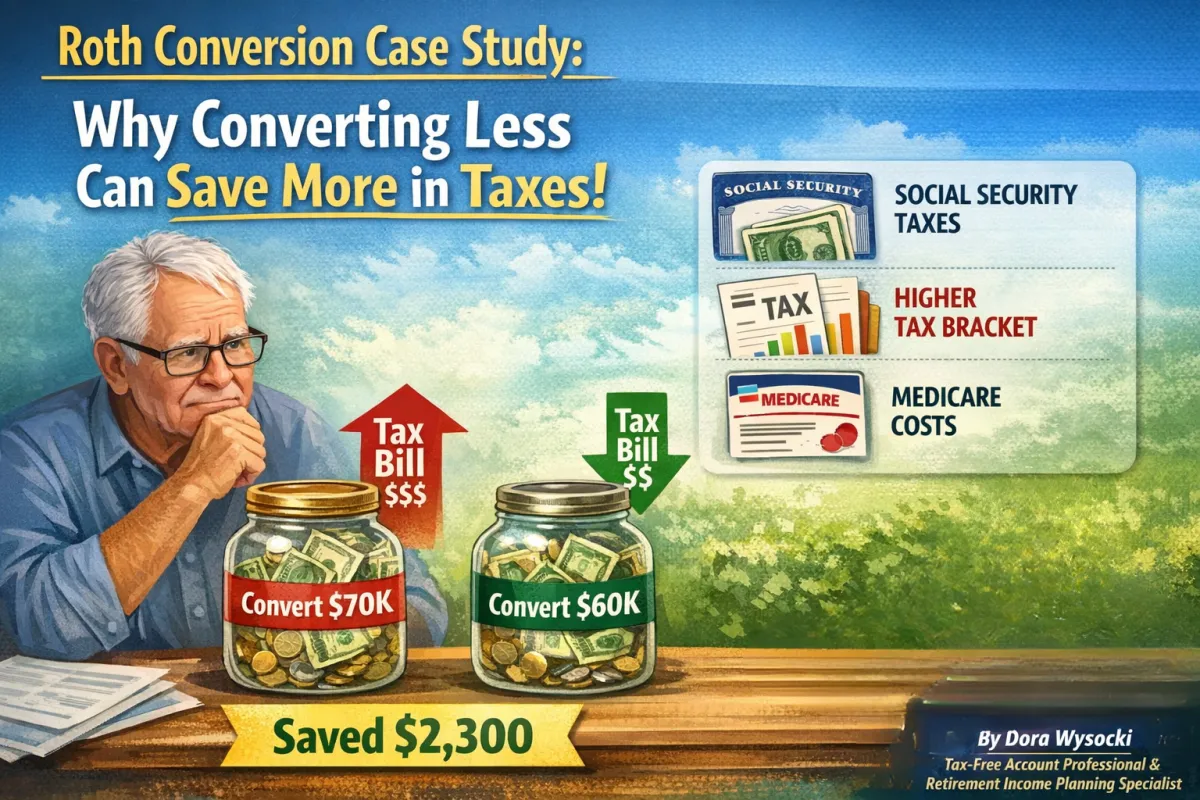
Strategy Comparison: $70k vs. $60k
We tested two different conversion amounts for this retiree to see which was more "efficient."
Scenario A: The $70,000 Conversion
The Intent: Maximize the move to tax-free growth.
The Reality: Total AGI hits ~$106,000.
The Result: This pushes the retiree deep into the 22% federal bracket and completely phases out a large portion of the $6,000 Senior Deduction.
Federal Tax Bill: ~$13,000
Scenario B: The $60,000 Conversion
The Intent: Stay below the "invisible" tax cliffs.
The Reality: Total AGI stays near ~$96,000.
The Result: By converting $10,000 less, we preserved more of the Senior Deduction and kept more Social Security income in the 10% and 12% effective ranges.
Federal Tax Bill: ~$10,800
The Math: By converting $10,000 less, the retiree saved $2,300 in taxes. That "extra" $10,000 in Scenario A was effectively taxed at a 23% combined rate—far higher than the retiree expected.
The Hidden Danger: The Medicare "Cliff" (IRMAA)
While saving $2,300 in taxes is significant, there is a bigger "ghost" in the room: IRMAA (Income Related Monthly Adjustment Amount).
Medicare premiums are not a sliding scale; they are a cliff. For a single filer in 2026, crossing the income threshold (often starting around $103,000–$106,000) by even one dollar can trigger a surcharge that adds over $800–$1,000 per year to your Part B and Part D premiums.
In Scenario A, the $70k conversion puts the retiree right on the edge of this cliff. One small error in math could result in a "tax" that doesn't show up on a 1040, but disappears from your Social Security check every month.
Is Your Strategy Based on Assumptions?
This case study assumes the Standard Deduction. However, if you have significant medical expenses or charitable contributions, you might be Itemizing.
If you itemize, your "efficient" conversion number might be much higher—or lower. This is why "Rule of Thumb" planning is the enemy of a successful retirement.
🔑 Key Takeaways
WV Residents: Your state tax is lower, but your federal "Tax Torpedo" risk remains high.
Watch the Deduction: Don't let a large Roth conversion "eat" your $6,000 Senior Deduction.
Mind the Cliff: Always check your IRMAA brackets before finalizing a conversion.
Ready to find your "Magic Number"? Don't guess with your retirement savings. Let’s look at your specific Social Security, deductions, and goals to build a multi-year plan that minimizes your lifetime tax bill.
👉 Schedule Your 2026 Retirement Tax Review Here
Disclaimer
Not Financial or Tax Advice: The information provided in this article, including the 2026 Roth conversion case study, is for educational and illustrative purposes only. It does not constitute investment, tax, or legal advice. Tax laws—including the 2026 Enhanced Senior Deduction, federal tax brackets, and Social Security taxation rules—are subject to change and may vary significantly based on individual circumstances such as filing status, itemized deductions, and additional income sources.State-Specific Accuracy: While this article mentions West Virginia’s 2026 Social Security tax exemptions, state tax laws are subject to legislative updates. Residents of other states should consult their local tax codes, as Roth conversion impacts vary by jurisdiction.Medicare (IRMAA) Risks: Income-Related Monthly Adjustment Amount (IRMAA) brackets are determined by the Social Security Administration based on tax returns from two years prior. A Roth conversion today could impact your Medicare premiums in the future.Consult a Professional: Because retirement planning involves complex interactions between the IRS, Social Security, and Medicare, you should not take action based solely on this information. Always consult with a qualified tax professional, CPA, or fiduciary financial advisor before executing a Roth conversion or making significant changes to your retirement strategy.
