
Long-Term Care
Planning for Healthcare and Long-Term Care Costs — One of the Larger Variables in a Retirement Plan
I use protection-based tools to help reduce the impact market volatility can have on a retirement plan.
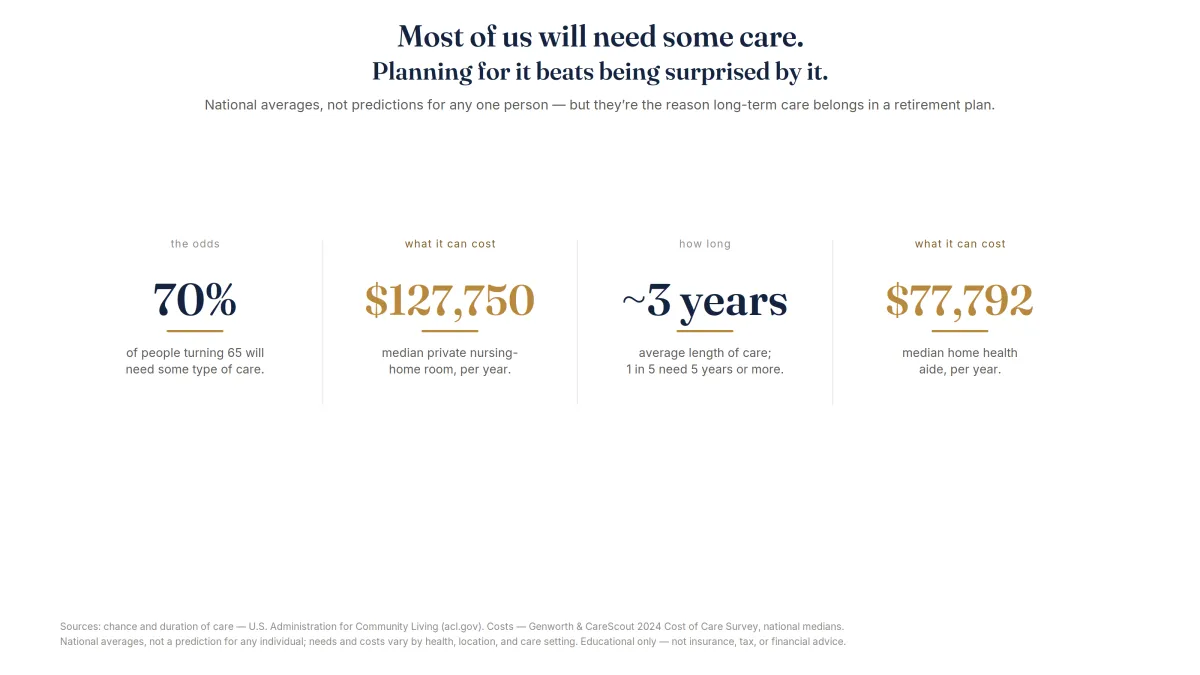
Estimates suggest that many people turning 65 may need some form of long-term care during their lifetime, and costs vary widely by setting and region — a private nursing-home room can exceed $100,000 per year, and home health aide care commonly falls in the $60,000–$80,000 range. [Add sources + year — see Step 8.]
Traditional long-term care insurance is often a use-it-or-lose-it product: if premiums are paid for years and care is never needed, much of what was paid may not return value. That is a common reason this risk goes unaddressed.
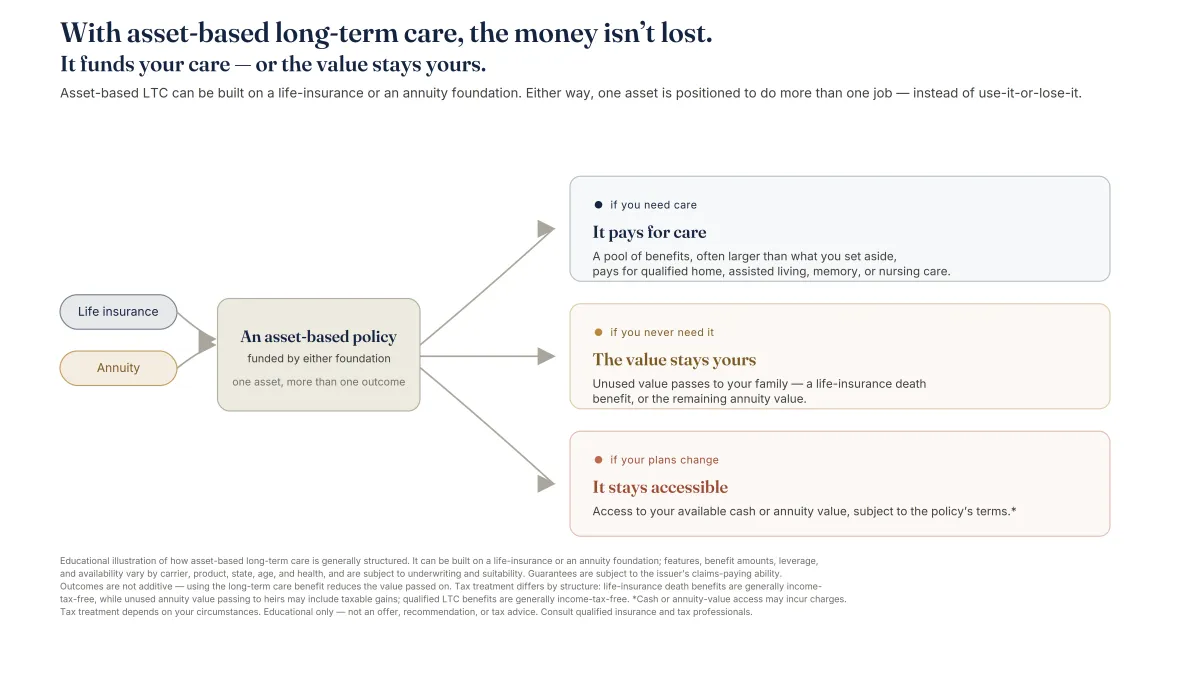
Hybrid Life and Long-Term Care solutions offer a two-outcome structure. A premium deposit funds a permanent life insurance policy with a long-term care acceleration rider. If qualifying care is needed, a benefit pool is available for care settings such as home care, assisted living, memory care, or a nursing facility — generally on an income-tax-free basis. If care is never needed, a generally income-tax-free death benefit may pass to your family instead. Benefits, eligibility, and tax treatment depend on the specific policy and your circumstances; consult a qualified tax professional. Guarantees are backed solely by the claims-paying ability of the issuing insurance company.
Guarantees are backed solely by the claims-paying ability of the issuing insurance company.
Beyond Insurance — A Contractual Structure, Not a Probability Estimate
The moment the policy is in force, the long-term care benefit pool is established — with a known amount, a known duration design, and clearly defined qualifying conditions. Benefits are paid as a tax-free accelerated death benefit under IRC Section 101(a). Premiums are contractually fixed at policy inception.
Guarantees are backed solely by the claims-paying ability of the issuing insurance company.
The Two-Outcome Structure — Care or Legacy, Never Neither
If qualifying care is needed, the benefit pool may help reduce out-of-pocket family expenses for covered care, may help keep retirement accounts intact, and can help protect the surviving spouse’s financial security. If care is never needed, a generally income-tax-free death benefit may pass to heirs under IRC Section 101(a). Tax treatment depends on your circumstances; consult a qualified tax professional.
Why Pre-Retirees and High-Net-Worth Families Choose Hybrid LTC — Three Structural Reasons
Reason 1 — Contractually Fixed Premiums
Traditional LTC premiums have increased materially over time in some cases — state regulators have permitted increases as long-term care costs have risen. Hybrid. LTC premiums are contractually fixed at policy inception. The premium in year one is the premium in year twenty.
Reason 2 — Asset Protection and Spend-Down Prevention
Without a plan, a long-term care event may require asset depletion before Medicaid eligibility. For a couple, this can mean one partner liquidating shared savings while the other is left with reduced resources. A hybrid LTC policy creates a dedicated benefit pool that responds first — protecting retirement accounts and the surviving partner’s financial security.
Reason 3 — Self-Contained Contract,
Hybrid LTC solutions are self-contained insurance contracts. They do not require portfolio liquidation, market timing, or investment account access. The benefit pool is available regardless of market conditions in the year care is needed.
DW Financial Group · (908) 738-9836