
Tax Deferral Built the Account. Tax Coordination Is What Protects It.

You’ve spent decades earning your wealth. Allowing inefficient tax strategies erode your savings in retirement is a failure of discipline. We coach you on the proactive tax coordination needed to protect your future and your legacy.
Retirement Tax Coordination
Tax Deferral Built the Account. Tax Coordination Is What Protects It.
I coordinate tax-advantaged and Roth strategy with your CPA — beyond what a 401(k) alone can do.
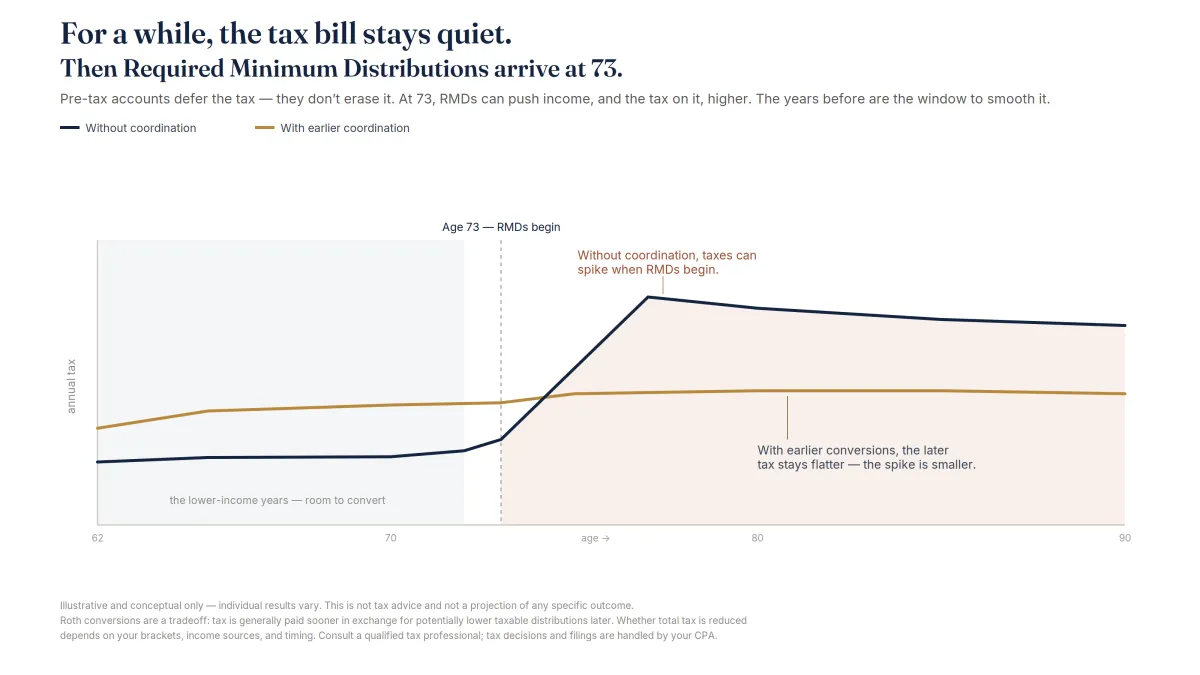
Your 401(k) grew because the contributions were deductible and the growth was tax-deferred. The advice to maximize it was correct — for accumulation. The less visible reality is that every dollar coming out is taxed as ordinary income. Required Minimum Distributions at age 73 force withdrawals whether the income is needed or not. Social Security income can become partially taxable. Medicare premiums may rise based on income thresholds.
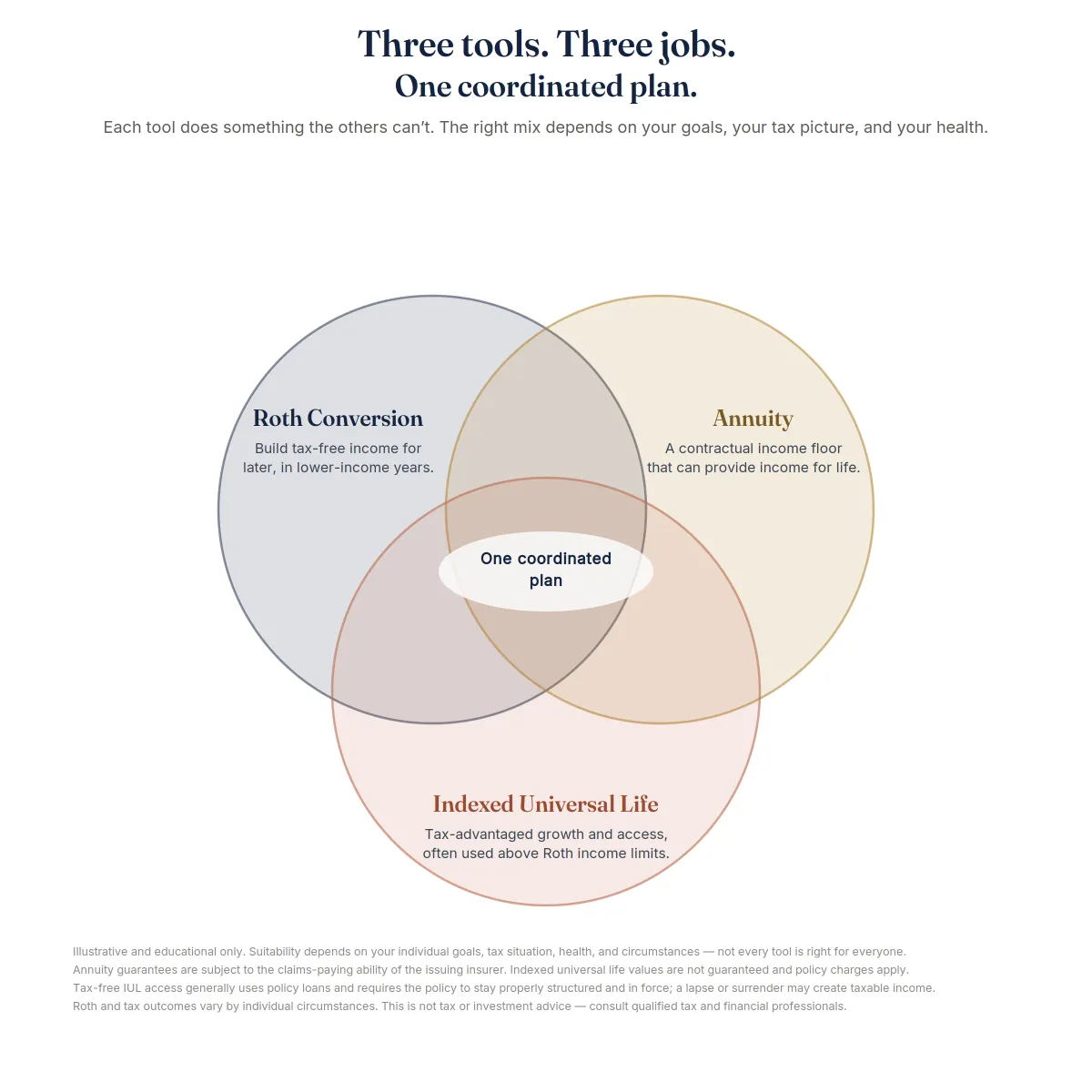
The CTS™ designation I am completing — alongside my CAS® — means I am trained to see the income picture and the tax picture together. Three insurance-based tools can be coordinated to address this: a Roth conversion reduces the pre-tax balance that will eventually force taxable distributions; an IUL under IRC Section 7702 may provide tax-deferred growth with the potential for generally income-tax-free access through policy loans when it is properly structured and kept in force; and an annuity income floor lowers taxable withdrawal needs and creates bracket capacity for more efficient annual conversions.
Your CPA executes the tax strategy. This practice designs the insurance architecture and delivers a complete coordination picture before they file. Suitability depends on individual circumstances; consult a qualified tax professional.
The Three Tax Traps
Three Places a Retirement Plan Loses to Taxes
Trap 1 — RMD Shock
Failure to plan for Required Minimum Distributions at age 73 can trigger higher taxes than expected. We forecast and model this well in advance.
Trap 2 — Roth Conversion Indecision
Conversions require precise timing. We model converting now versus facing a larger pre-tax balance later — and hand the numbers to your CPA.
Trap 3 — The Coordination Gap
Tax planning is not an annual event. We keep the insurance architecture and your CPA's tax strategy coordinated on a forward-looking schedule.
The Three-Tool Coordination System. Each Tool Has a Role. Together, They Work as One.
Tool 1 — Roth Conversion Coordination
The pre-RMD window between retirement and age 73 is a meaningful tax-planning period. Converting a bracket-appropriate amount each year — modeled to stay below IRMAA surcharge thresholds and manage Social Security taxation — can reduce the lifetime tax burden. This practice identifies the window; your CPA determines the amount, manages IRMAA, and executes the filing.
Tool 2 — IUL: Tax-Free Accumulation
For earners above the Roth IRA phase-out, an IUL under IRC Section 7702 provides tax-free accumulation with no IRS contribution limits and no RMDs. Cash value grows tax-deferred with a zero indexed-credit floor; income is distributed tax-free through policy loans.
Annual insurance charges apply. Policy loans and withdrawals reduce the death benefit and cash value.
Tool 3 — Annuity: Lower the Taxable Baseline
A contractual income floor may reduce the amount you withdraw from taxable accounts each year — creating more bracket capacity for conversions and easing pressure on the IUL during downturns. It is the structural foundation of the whole system.
A contractual income floor may reduce the amount you withdraw from taxable accounts each year — creating more bracket capacity for conversions and easing pressure on the IUL during downturns. It is the structural foundation of the whole system.
Illustrative Example
How the Three-Tool System Has Been Applied — An Illustrative Example
The following is an illustrative example based on general planning concepts. Individual results vary based on income, tax bracket, product structure, CPA strategy, and applicable law. This is not a guarantee of any specific outcome.
A married couple in their early 60s came in with a combined pre-tax retirement balance exceeding $1.4 million, Social Security beginning at 65, and Medicare at 65. Their concern: the 401(k) RMDs starting at 73 would push them into a higher bracket, raise Medicare premiums, and make part of their Social Security taxable.
The insurance architecture coordinated three tools: a Fixed Index Annuity providing a contractual income floor from age 70; an IUL under IRC Section 7702 for tax-free income in later years; and an income floor that kept taxable income low during ages 62–72, so annual Roth conversions — modeled and executed by their CPA — moved a portion to a tax-free structure before RMDs began.
The result: a coordinated income and tax picture presented to their CPA before year-end each year — with no AUM fees for the insurance architecture design.
DW Financial Group · (908) 738-9836